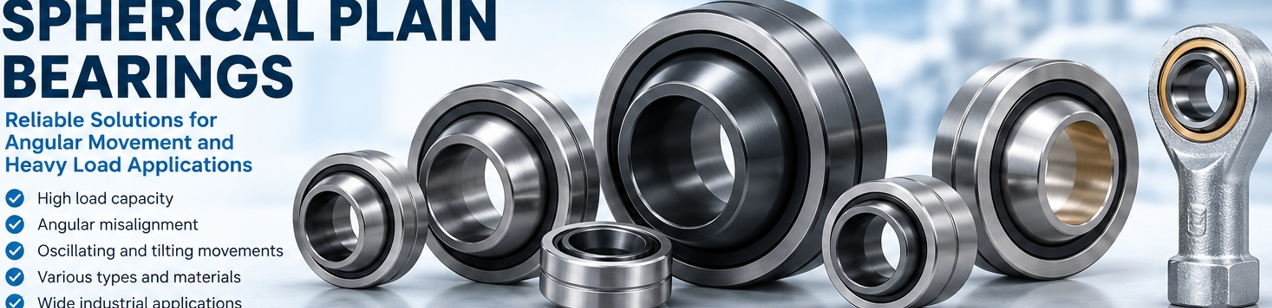
Spherical plain bearings, also known as spherical sliding bearings, are mechanical components designed to accommodate angular misalignment and support loads in applications involving oscillating, tilting, and pivoting movements.
Unlike conventional rolling bearings, spherical plain bearings operate through sliding contact between two matching spherical surfaces. They typically consist of an inner ring with a convex spherical outer surface and an outer ring with a corresponding concave spherical inner surface.
This unique design allows the inner ring to move at an angle relative to the outer ring, making spherical plain bearings particularly suitable for mechanical connections where alignment changes during operation.
Spherical plain bearings are widely used in construction machinery, hydraulic equipment, agricultural machinery, mining equipment, industrial automation, and other applications requiring reliable load support and angular movement.
The operating principle of a spherical plain bearing is based on the sliding movement between its inner and outer rings.
The inner ring has a spherical sliding surface that fits into the matching spherical surface of the outer ring. During operation, these surfaces slide against each other, allowing the bearing to accommodate angular displacement and oscillating movements.
Depending on their design, spherical plain bearings can support radial loads, axial loads, or a combination of both.
Because they do not rely on rolling elements, spherical plain bearings are particularly useful in applications involving heavy loads, relatively slow movements, and changing alignment conditions.
However, the operating performance of a spherical plain bearing depends on several factors, including load, sliding speed, lubrication, bearing materials, temperature, and environmental conditions.
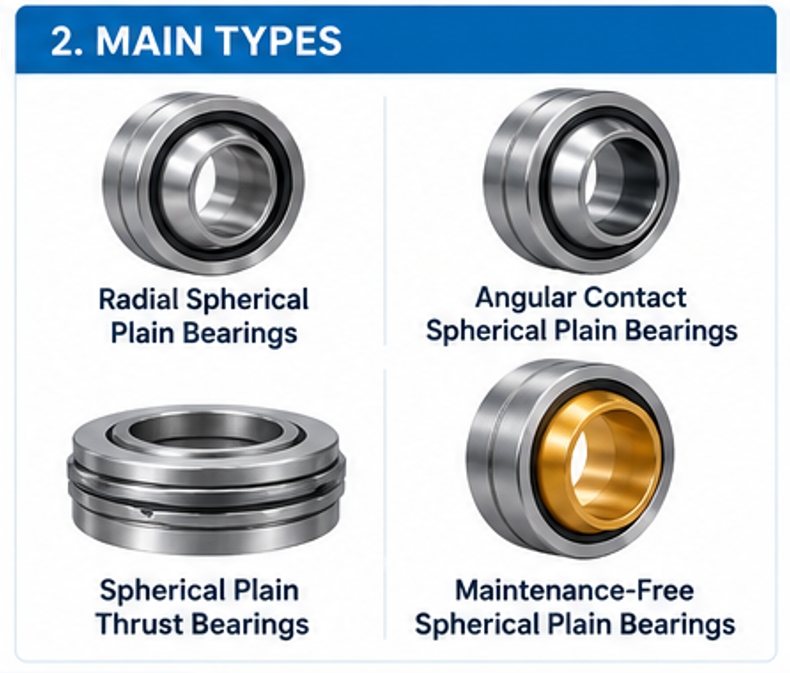
Spherical plain bearings are available in different designs to meet various load and movement requirements.
Radial spherical plain bearings are primarily designed to support radial loads while accommodating angular misalignment and oscillating movements.
They are among the most widely used types of spherical plain bearings in industrial machinery.
Depending on the bearing series, radial spherical plain bearings may feature steel-on-steel sliding contact or maintenance-free sliding materials.
Typical applications include:
Hydraulic cylinder connections
Construction machinery
Agricultural equipment
Mechanical linkages
Industrial pivoting mechanisms
Common product series include GE...E, GE...ES, GE...ES-2RS, GE...UK, and other radial spherical plain bearing designs.
Angular contact spherical plain bearings are designed to accommodate combined radial and axial loads.
Their inclined spherical sliding surfaces allow them to support axial loads in one direction in addition to radial loads.
When axial loads act in both directions, an appropriate paired arrangement may be required.
These bearings are commonly used in heavy-duty mechanical assemblies where combined loading occurs.
Spherical plain thrust bearings are primarily designed to accommodate axial loads while allowing angular adjustment.
Their spherical sliding surfaces help compensate for angular misalignment between connected components.
They are suitable for applications where axial loading is the main operating requirement.
Maintenance-free spherical plain bearings use specialized sliding materials, such as PTFE-based liners or other self-lubricating materials, depending on the product design.
These materials help reduce friction and eliminate the need for periodic relubrication under specified operating conditions.
Maintenance-free designs are particularly useful in applications where regular lubrication is difficult or where reduced maintenance is required.
The suitability of a maintenance-free bearing depends on load, movement, temperature, contamination, and the selected sliding material.
Selecting the correct sliding contact material is important for bearing performance and service life.
Steel-on-steel spherical plain bearings are designed for applications requiring high load-carrying capacity and robust mechanical performance.
Their sliding surfaces typically require appropriate lubrication to reduce friction and wear.
These bearings are commonly used in heavy-duty construction machinery, hydraulic equipment, and industrial applications involving substantial loads and oscillating movements.
Maintenance-free spherical plain bearings use low-friction sliding materials that are designed to operate without periodic relubrication under specified conditions.
They are often selected for applications where maintenance access is limited or where lubrication should be minimized.
The choice between steel-on-steel and maintenance-free bearings should be based on the actual operating conditions rather than load capacity alone.
Spherical plain bearings are available in designs capable of supporting heavy radial, axial, or combined loads.
Their load-carrying capability makes them suitable for demanding industrial applications.
The spherical sliding contact allows the bearing to accommodate angular displacement between connected components.
This feature is particularly valuable in mechanical systems where perfect alignment cannot be maintained throughout operation.
Spherical plain bearings are well suited to slow oscillating, tilting, and pivoting movements.
They are commonly used in joints and linkage systems where continuous high-speed rotation is not required.
Many spherical plain bearing designs provide substantial load-carrying capability within relatively compact dimensions.
This can be beneficial for equipment with limited installation space.
Different sliding contact materials allow spherical plain bearings to be selected according to load, lubrication requirements, maintenance accessibility, and environmental conditions.
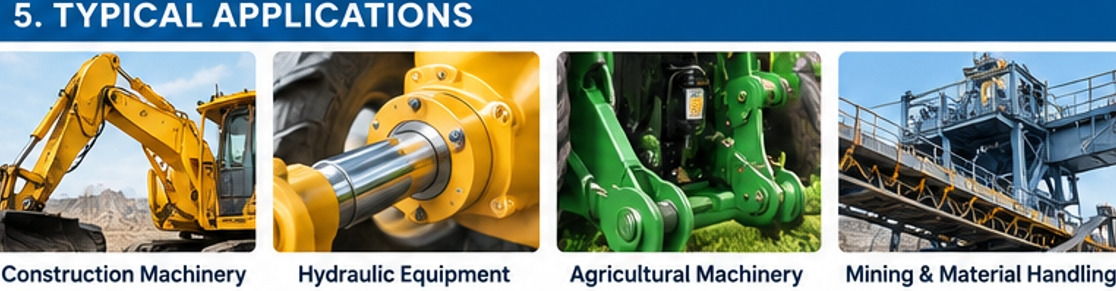
Spherical plain bearings play an important role in many industries.
Construction machinery frequently operates under heavy loads, vibration, and changing working conditions.
Spherical plain bearings can be used in suitable pivot joints, hydraulic cylinder connections, and articulated linkage mechanisms in excavators, loaders, and other earthmoving equipment.
Their ability to support heavy loads while accommodating angular movement makes them valuable components in demanding construction applications.
Hydraulic cylinders often require pivoting connections that accommodate changes in angle during extension and retraction.
Spherical plain bearings are commonly used in suitable hydraulic cylinder mounting arrangements to support loads and permit angular movement.
Agricultural equipment frequently operates under changing loads and environmental conditions.
Spherical plain bearings can be used in mechanical linkages, articulated connections, and other moving assemblies in tractors, harvesters, and agricultural implements.
Mining machinery and material handling systems may require bearings capable of supporting substantial loads while allowing oscillating or pivoting movements.
Appropriately selected spherical plain bearings can provide reliable articulation in these applications.
Certain industrial automation systems and robotic linkage mechanisms require angular movement and alignment compensation.
Spherical plain bearings can be used in suitable joints and mechanical connections, depending on the required precision, load, movement, and operating conditions.
Choosing the correct spherical plain bearing requires careful consideration of the operating conditions.
1. Load Requirements
Determine the magnitude and direction of the applied loads, including radial loads, axial loads, and any impact or reversing loads.
2. Type of Movement
Identify whether the bearing will experience oscillating, tilting, pivoting, or rotational movement, and consider the movement frequency and sliding speed.
3. Angular Misalignment
Confirm the required angular movement and ensure that the selected bearing design provides sufficient misalignment capability.
4. Sliding Contact Material
Choose between steel-on-steel and maintenance-free sliding materials according to load, movement, lubrication, and maintenance requirements.
5. Operating Environment
Consider temperature, dust, moisture, corrosion, and other environmental factors that may affect bearing performance.
6. Lubrication and Maintenance
For bearings requiring relubrication, establish an appropriate lubrication method and maintenance interval.
7. Dimensions and Installation
Verify the bearing dimensions, tolerances, internal clearance, shaft and housing fits, and installation requirements.
Correct bearing selection and installation are essential for reliable operation and service life.
SPB Bearings is a professional manufacturer of spherical plain bearings with over 20 years of manufacturing experience.
Supported by a professional R&D team, efficient production capabilities, and sufficient inventory of regular bearing models, we are committed to providing reliable bearing products and responsive service.
Our product range includes radial spherical plain bearings, angular contact spherical plain bearings, spherical plain thrust bearings, rod ends, and other bearing solutions for industrial applications.
We understand that different applications require different bearing characteristics.
By combining manufacturing expertise with practical application knowledge, we help customers identify suitable bearing products and address technical challenges.
Whether you are an industrial distributor, machinery manufacturer, equipment maintenance company, or spare parts supplier, SPB Bearings is ready to support your bearing requirements.
Looking for reliable spherical plain bearings for your equipment or industrial application?
Contact SPB Bearings for product information, technical drawings, bearing selection assistance, and quotations.
SPB Bearings — Professional Spherical Plain Bearing Solutions for Your Applications.
Zhangzhou SPB Bearings Corporation Limited is a specialized manufacturer dedicated to the development and production of spherical plain bearings and related bearing products. With over 20 years of experience in spherical plain bearing technology and manufacturing, we serve customers across a wide range of industrial sectors with dependable products and application-oriented solutions.....[ Read More >>]


